Expert Financial Advice UK Wide

Trusted advice on pensions & retirement, mortgages, inheritance tax planning, and more.

Local Savings & Investment Advice

Top Rated Savings & Investment Advice

Looking for a trusted financial adviser to grow your wealth? We provide personalised savings and investment strategies designed to help you achieve your financial goals. With expert, independent advice, we’ll help you make smart, informed decisions - so your money works harder for you now and in the future.

Rated Excellent.. Don't just take our word for it!

Local Savings & Investment Advisers

Why Should You Invest?

People invest for many reasons which help establish their financial goals. Some of the most common reasons you might invest include:
Build your wealth: Investing intelligently over time can create wealth, financial freedom, and security through various strategies, fostering prosperity and growth.
Live happily in retirement: Early strategic investing for retirement harnesses time and compounding - earning interest - potentially securing a worry-free, desired lifestyle in your golden years.
Generate an income: Investment generated income provides alternative earning, potentially safeguarding you against economic downturns and unforeseen life events.
Work towards a better future: Investing goes beyond profit. Responsible investment in sustainability, social justice, and the environment can leave a positive legacy for future generations.
Build generational wealth: Long-term investing can build generational wealth and a legacy to leave, allowing you to empower a prosperous future for your loved ones.

Before You Invest

Think about your current financial situation and where investing fits within your wider financial journey. Your financial adviser will help you with this
Do you have enough money to invest?
Assess your current financial situation and consider whether you can allocate a portion of your savings without compromising your immediate financial obligations or future goals.
Do you have outstanding debts?
Prioritise paying off high-interest debts, such as credit card balances or high-interest loans. High-interest debts can erode your financial stability and potential investment gains.
Have you built up emergency cash savings?
Unforeseen events like home repairs or sudden unemployment may be costly. Before committing to investing, establish an emergency cash savings fund. Ideally, this fund covers three to six months’ worth of living expenses and acts as a safety net.
Do you have adequate financial protection?
What would happen if you were off work due to sickness or an accident? Your financial adviser can help set up the financial protection you need.
How long can you leave your money invested?
Consider your objectives for this money and whether this means that there is a certain time frame when you would want to access it. For example, paying for a wedding, anniversary, or children’s school fees
Your financial adviser will support you and give tailored advice to suit your personal circumstances.
BOOK A CALL

The Real Value of Financial Advice

" Most unadvised customers would experience better financial outcomes if they followed professional financial advice."
Source: Adviser Delta, a Quilter research paper on the importance of advice, June 2019.

Please note, this research was originally conducted in 2016. The figures quoted are likely to have changed over time and should not be used as advice. It is intended for illustrative purposes only.

Consider this example:

Average retirement income without financial advice £17,168.
Average retirement income with financial advice £24,175. This is 40% higher (£7,007) than without financial advice.
Over a 21-year retirement, this means having an extra £147,147.

Whether you prefer a local adviser visiting you in person or a remote consultation by phone or video call, we tailor our service to meet your needs, wherever you are in the UK.

Local Savings & Investment Advisers

Simple Steps to Investing

The five simple steps below will help you get started on your investing journey

Why Should I Invest?

Not sure where to start? One of the most important decisions you will make on your investing journey is the decision to start. It’s important to be focused on what you want to achieve. Your financial adviser will be able to help you with this.

What is Investment Risk?

Risk is an integral part of investing. To get higher potential returns, you need to take risk. How much you take depends on a lot of things. We have created six investor risk profiles to help you understand how much risk you are comfortable taking.

How Can I Invest?

There are thousands of funds available across the whole market which can be used to build your investment portfolio. Your financial adviser will typically allocate one diversified managed portfolio for each distinct financial objective you have.

What is the role of my financial adviser?

Your financial adviser will do a great deal more for you than simply recommend what you should invest in. Investing is just one part of the overall picture and should never be considered in isolation.
It’s important to understand that investing is a long-term commitment. When you invest, your money is used to buy different types of assets with the aim of them growing in value over time.

Your financial adviser is here to make your investing journey smooth and stress-free. They’re ready to guide you through every step, explaining everything clearly, and make any decisions with you.

Local Savings & Investment Advice

Our Savings & Investment Services

We offer a wide range of investment options tailored to your unique financial goals, whether you're looking to build long-term wealth, save for a specific target, or diversify your portfolio. Our expert advisers provide personalised advice, helping you navigate the investment landscape with confidence and clarity.

Bonds

Navigating the world of bonds can be complex, but we specialise in offering tailored solutions to meet your investment goals. Whether you're seeking secure, fixed-income opportunities or looking to diversify your portfolio, our expert advisers provide personalised recommendations to help you build a stable and balanced investment strategy.
Book your first appointment for free here > 

Junior ISA's

Investing for your child’s future can be a rewarding step, and we specialise in providing tailored Junior ISA solutions to help you grow their savings. Whether you’re looking for long-term growth or secure savings options, our expert advisers will guide you in choosing the most suitable Junior ISA to suit your goals and provide a strong financial foundation for your child’s future.
Book your first appointment for free here > 

ISA's

Aim to maximise your tax-advantaged savings with our tailored ISA solutions, designed to help you grow your wealth efficiently. Whether you're looking for a cash ISA or stocks and shares ISA, our expert advisers will guide you in selecting the most suitable ISA to meet your financial goals.
Book your first appointment for free here > 
ISA’s investors do not pay any personal tax on income or gains, but ISAs may pay unrecoverable tax on income from stocks and shares received by the ISA managers. Tax treatment varies according to individual circumstances and is subject to change.

Stocks and Shares ISAs invest in Corporate bonds; stocks and shares and other assets that fluctuate in value.

Off-Shore Collectives

Explore the benefits of offshore collectives with tailored solutions designed to help you diversify your investment portfolio. Our expert advisers provide guidance on offshore opportunities, ensuring you make informed decisions to potentially optimise returns while managing risk.
Book your first appointment for free here >

Equities

Investing in equities offers long-term growth potential. Rather than direct share dealing, we provide access to equity funds, offering diversification and professional management to help balance risk and reward. Alternative investments can be high risk and may be difficult to sell. Their value and any income may fluctuate, meaning investors could get back less than they invested, even with tax benefits.
Book your first appointment for free here >

Collectives

Collectives offer a flexible and diversified way to invest, pooling resources with other investors to access a range of assets. Our expert advisers help you choose collectives that fit your investment strategy, giving you the potential to benefit from professional management and diversification while aiming for long-term growth.
Book your first appointment for free here >

Unit Trusts

Unit trusts allow you to invest in a diverse range of assets, managed by professional fund managers. Our expert advisers will guide you in selecting unit trusts that align with your financial goals, providing a balanced approach to risk and return for your long-term investment strategy.
Book your first appointment for free here >

Fixed Interest Investments

Fixed interest investments offer a stable income stream with a predictable return, making them an attractive option for risk-averse investors. Our expert advisers help you navigate a range of fixed interest opportunities, ensuring your investment strategy aligns with your financial objectives and risk tolerance.
Book your first appointment for free here >

Open Ended Investment Companies

Open-Ended Investment Companies (OEICs) offer flexibility and diversification by pooling funds from multiple investors into a range of assets. Our expert advisers will guide you in selecting OEICs that match your investment goals, providing you with a diversified portfolio and the potential for long-term growth.
Book your first appointment for free here >

Why choose Beals Financial Advisers?

Working with our financial advisers offers trusted expertise, personalised guidance, and tailored strategies to achieve your financial goals:
We take a comprehensive view of your financial situation, considering factors such as insurance, mortgages, retirement, savings and investments, estate planning, and cash flow management.
We can provide strategies to minimise tax liabilities, ensuring you keep more of your money.
We can help you develop and manage an investment portfolio that aligns with your financial objectives and risk profile.
We have access to a wide range of financial products and tools that may not be available to individual investors.
SPEAK TO AN ADVISER

Local Savings & Investment Advisers

How Do We Choose What You Invest In?

Being part of Quilter Financial Planning means we have access to the latest industry expertise that covers the performance of every fund and portfolio in detail. The funds and portfolios your Beals adviser will recommend go through a thorough vetting process and are continuously monitored on an ongoing basis.

Investment Research

We conduct in-depth research on the funds and portfolios to ensure every fund and portfolio can meet customer needs.

Ongoing Monitoring

We monitor the funds and portfolios on an ongoing basis, with the help of independent experts, to answer the questions below.

Oversight & Governance

We have robust governance processes and structures in place to ensure good outcomes and fair treatment for you.

Our technical experts review every fund and portfolio against the below nine questions, so you don’t have to:

1
Is it a diversified multi-asset portfolio?
2
Is it risk-targeted, or does it have very stable risk levels?
3
Is it professionally managed?
4
Does it have a clear investment objective
5
Are we happy the management style does not excessively favour growth or value?
6
Is it priced daily?
7
Are we happy with the liquidity of the underlying holdings?
8
Is it transparent?
9
Can we confirm there are no governance risks?
Only portfolios which can answer ‘yes’ to all the questions above make the grade.
Your financial adviser will support you and give tailored advice to suit your personal circumstances.
BOOK A CALL

Local Savings & Investment Advice

What Are the Main Risks of Investing?

Investing comes with risks. Balancing risk and return is the main challenge of investing and it is a key part of the value you receive from working with a financial adviser.
The amount of risk you take is closely linked to the return potential of any investment. The more risk you take, the more potential you have for a higher return.

Here are some of the main risks you will need to consider:
Investment risk: The risk of your investments losing value in the shorter term.
Example: If you buy company shares or bonds, the value of your investments are impacted by how the economy is doing, political events, or company performance, so your investments can go up or down.
Goal risk: The risk of your investments not growing enough for you to meet your goals.
Example: You may not be able to retire when you want to or help your children to get on the property ladder.
Longevity risk: The risk of outliving your income.
Example: You might live longer than expected and your money runs out when you are in retirement.
Event risk: The risk of unexpected events that affect your plan.
Example: You face a medical situation, and you’re forced to retire earlier than planned.
Savings risk: The risk of not saving enough to invest.
Example: You may have unexpected expenses like car repairs or medical bills and you might end up spending the money you planned to save.
Inflation risk: The risk of inflation eroding your savings.
Example: Your investments don’t grow at a rate higher than inflation so your money is worth less than what it is today and doesn’t have the same purchasing power
Interest rate risk: The risk of changes in interest rates affecting your expenses.
Example: Interest rates go down, so any savings in a bank account don’t earn as much, or interest rates go up and your mortgage payments increase.
It’s important to understand that not even the world’s foremost investment experts know exactly what markets are going to do and when.

Investment Risk Profiles

We use six risk profiles when recommending investments. Your financial adviser will help you to decide what kind of risk you are comfortable with and why.
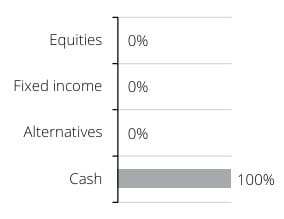
The key driver of the risk level of your investments will be their asset allocation. In other words, how much is invested in riskier assets like equities (company shares), and how much is in lower risk assets like government bonds. As you can see, in the dynamic and adventurous profiles the investment in equities is far higher than for the risk-averse and conservative portfolios. Please note that the asset splits below are examples only. No actual portfolios will exactly replicate these splits. For illustration purposes only.

Risk Averse

Risk-averse investors are not happy taking any risk that can be avoided.
Example asset allocation

Conservative

Conservative investors are careful
about investing in the stock market.
However, they understand that this
may be necessary to reach their
goals. They will feel disappointment
if any actions they take do not have
a good outcome.
Example asset allocation

Balanced

Balanced investors do not take
much risk with their money.
However, they know that higher-risk
investments can give better returns
over time, so are willing to take some
risk. They would regret any decision
that failed to lead to a return.
Example asset allocation

Moderate

Moderate investors understand
that they will probably have to take
a degree of investment risk to reach
their long-term goals. They are
likely to be willing to take risk with
a significant proportion of their
available assets
Example asset allocation

Dynamic

Dynamic investors know that higher
risk investments can bring significant
returns in the long run. They are
usually willing to take risks with most
of their money to achieve their goals.
They accept that occasional poor
returns are a necessary part of a
long-term investment.
Example asset allocation

Adventurous

Adventurous investors look for a
high return on their capital and are
willing to take considerable risk to
achieve this, usually with all their
available assets
Example asset allocation

Local Savings & Investment Advice

How We Can Help

Your financial adviser will work closely with you to understand your personal situation and identify your purpose. 
They will also help you by:

Assessing what level of risk you are comfortable in taking

They will evaluate your comfort level with investment risk and your capacity for loss:
What is your investment experience and knowledge?
How comfortable are you with the risks of investing?
What level of risk do you need to take?

Determining your financial objectives

They will establish your hopes, aspirations, and concerns to tailor a plan that meets your needs:
What would you like to achieve?
When would you like to achieve it by?
What would you like to avoid along the way?

Evaluating your financial situation

They will consider how to invest to achieve your goals:
Are your assets held in the most appropriate name?
Do each of your assets have the right ownership, such as named beneficiaries?
Are each of your assets held in the right tax wrapper, such as ISAs and pensions?

Choosing the right investment solution

They will select the most suitable financial product for your needs:
Do your investments have the right level of return expectations?
Is the level of investment risk appropriate and in line with what you have agreed?
Can your investments be released if you need them to be?

Providing ongoing support

They will ensure that your investments continue to align with your goals in the future:
Consider any changes to your purpose, goals, or personal circumstances.
Check if any personal changes in income or capital values impact your current savings or tax situation.
Explain how any changes impact you in terms of welfare or income, capital, or inheritance tax changes

Frequently Asked Questions

What is the difference between saving and investing?

Saving typically involves setting aside money in a secure account for short-term goals or emergencies, earning minimal interest. Investing, on the other hand, involves putting money into assets like stocks, bonds, or funds with the aim of achieving higher returns over the long term, though it carries more risk.

How do I decide between a savings account and an investment?

If you need access to your money in the short term or want to minimise risk, a savings account is often more suitable. For long-term goals, investing could offer higher potential returns, though it comes with greater risk. The right choice depends on your time horizon, risk tolerance, and financial goals.

What types of investments are available to me?

Common investment types include stocks, bonds, mutual funds, property, and alternative investments like commodities or private equity. Each carries different levels of risk and potential returns.

How can I reduce the risk when investing?

Diversification is a key strategy for managing risk. By spreading your investments across different asset classes, sectors, and regions, you reduce the impact of poor performance from any single investment. Regular reviews and balancing your portfolio can also help manage risk.

What is an ISA, and how can it benefit me?

An Individual Savings Account (ISA) allows you to save or invest in a tax efficient account', up to the annual limit set by the government. There are different types of ISAs, including Cash ISAs, Stocks and Shares ISAs, and Lifetime ISAs, each offering unique benefits.

How much should I save or invest each month?

The amount depends on your income, expenses, and financial goals. A general rule is to save at least 20% of your income if possible, allocating some to an emergency fund and the rest toward long-term investments/savings.

What is compound interest, and how does it work?

Compound interest is the interest earned on both your initial principal and the accumulated interest from previous periods. This effect can significantly boost the value of your investments over time.

Are investments guaranteed to grow?

No, investments are not guaranteed to grow, and their value can fluctuate. While some investments historically provide long-term growth, there is always a risk of loss. It's important to invest according to your risk tolerance and financial goals.

Why should I review my savings and investments regularly?

Regular reviews help ensure your savings and investments remain aligned with your financial goals, risk tolerance, and any changes in your circumstances or market conditions. It also allows for adjustments with the aim of optimising performance and reduce unnecessary fees.

Do I need a financial adviser for my savings and investments?

While it’s possible to manage your own savings and investments, a financial adviser can provide expert guidance tailored to your specific goals and risk tolerance. Advisers help with creating a diversified investment strategy, tax planning, and navigating complex financial products, which can ultimately save you time, reduce risk, and potentially improve returns.

Book Your Free Consultation with a Local Financial Adviser Near You

We offer complimentary consultations with a local financial adviser, including a free review of your pensions and investments, along with our expert recommendations. It's free, no-obligation, no pressure. Fees only apply if you choose to proceed with our advisers recommendations, we will make you aware of any associated costs from the start.
Savings & Investment Page
Tax treatment varies according to individual circumstances and is subject to change.

The guidance and/or information contained within this website is subject to the UK regulatory regime and is therefore targeted at consumers based in the UK.

Approver Quilter Financial Services Limited. March 2025

Registered office address: Unit 1 Fulcrum 2 Solent Way, Whiteley, Fareham, England, PO15 7FN. Registered in England and Wales under reference 08286166
stareyeuseruserslaptopchart-barsmagnifiermenuchevron-downwarningquestion-circle linkedin facebook pinterest youtube rss twitter instagram facebook-blank rss-blank linkedin-blank pinterest youtube twitter instagram